
Reclaiming is a contemporary vanitas painting created at a pivotal moment in my life: the return to my professional artistic practice after a pause devoted to motherhood. Rooted in the vanitas tradition, an art form historically concerned with time, mortality, and the fleeting nature of worldly pursuits, this painting reframes those themes through the lens of lived experience, renewal, and conscious choice. Rather than lamenting impermanence, Reclaiming acknowledges it, and asks what remains worth holding.
Reclaiming was a meditative piece to paint and became a declaration of my renewed creative focus.
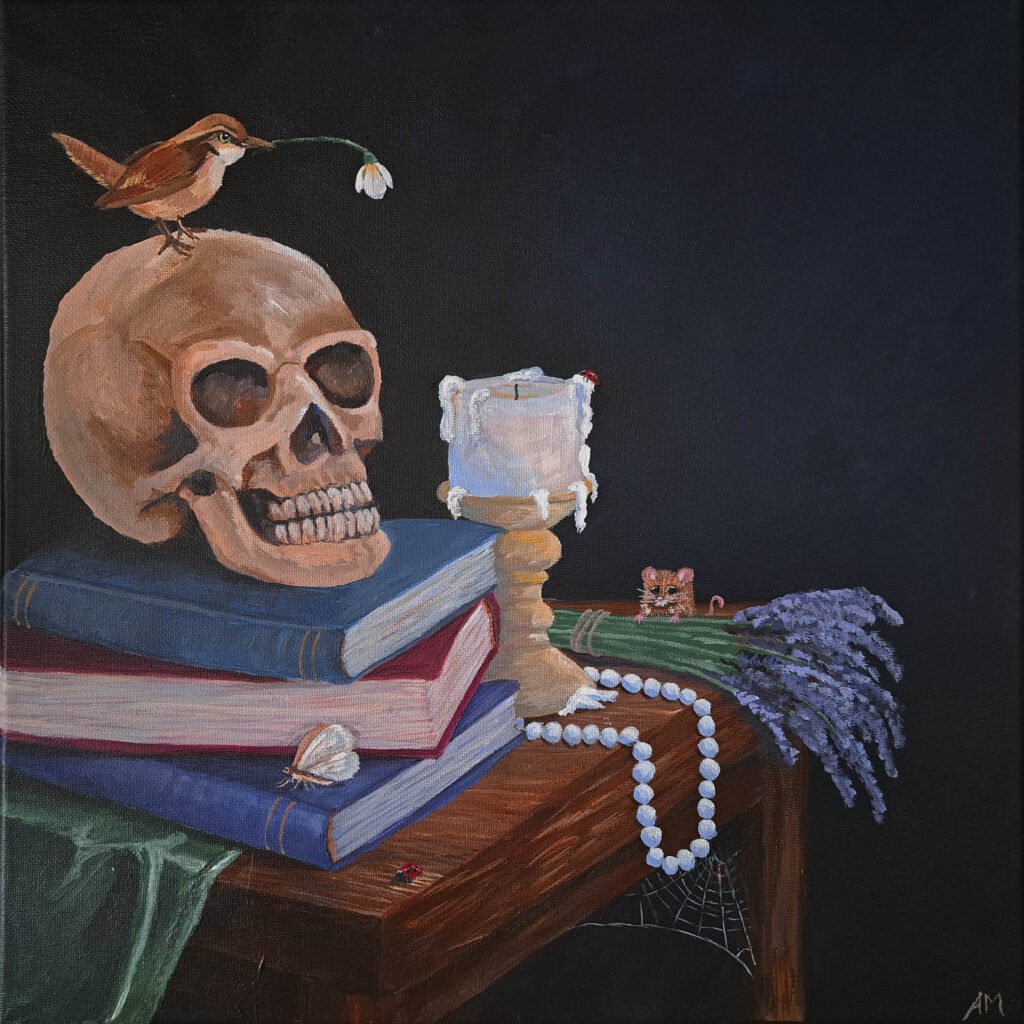
Amethyst Moon, 2025
Acrylic on Canvas
16 x 16 inches
Symbolism in Art
Art is full of symbolism. Little tidbits that allow you into the world and mindset of the artist. Symbolism in art functions as a visual language. One that allows complex ideas, personal histories, and emotional truths to exist without direct explanation. In Reclaiming, symbolism is not decorative but intentional, drawing from the vanitas tradition while expanding it into a contemporary, lived context.
Each object carries both collective meaning and personal significance: mortality, time, heritage, care, renewal, and choice coexist within a single frame.
Rather than offering fixed answers, the symbols invite contemplation, encouraging viewers to bring their own experiences into dialogue with the work. In this way, Reclaiming uses symbolism not to obscure meaning, but to deepen it - transforming a still life into a narrative of return, integration, and self-definition.
The Skull and the Weight of Knowledge
At the center of the composition rests a human skull, balanced atop a stack of worn books. In vanitas imagery, the skull is a reminder of mortality, a symbol meant to humble ambition and dissolve illusion.
Here, it does not dominate the scene, nor does it instill fear.
Instead, it sits calmly, supported by knowledge, memory, and experience. The books beneath it represent years of learning and creative growth. Knowledge that was never lost during my time away from professional art-making, only set aside. The skull becomes not an endpoint, but a grounding truth: life is finite, and therefore meaningful. We do not live forever; sometimes it is now or never for the dreams we wish to accomplish.
Slipping Fabric: Time Paused, Time Resumed
Draped beneath the books is a length of fabric slipping toward the edge of the table, held in place only by the books, by the knowledge collected over time.
Fabric, soft and yielding, contrasts with the hardness of bone and wood. Its slow descent speaks to the passage of time and the quiet labor that often goes unseen.
The Unlit Candle: Creative Potential Rekindled
Beside the books stands an unlit pillar candle held in a heavy, stone-like candlestick.
In traditional vanitas paintings, a candle often signifies the brevity of life as its flame burns down. Here, the candle remains unlit. Its wick is intact, its form solid and grounded. This choice speaks to creative potential rather than depletion. The flame has not burned out; it simply awaits ignition. The weight of the candlestick suggests commitment and stability, anchoring intention and resolve.
Lavender: Healing, Memory, and Self-Compassion
A sprig of lavender lies across the wooden surface, offering a quiet counterbalance to the heavier symbols.
Lavender has long been associated with remembrance, calm, and healing. Its presence acknowledges restoration and relaxation. It honors the emotional work required to return to oneself after long periods of outward focus.
Healing, in this sense, is not about undoing the past, but about integrating it.
The Mouse: Humility and Quiet Persistence
Peeking over the lavender’s stems is a small mouse - easy to overlook, yet intentionally placed.
The mouse represents humility, survival, and quiet persistence. It reflects the unnoticed labor and patience that sustains life behind the scenes. I have spent the last 17 years focused on being a mother. A stay at home caregiver, a homeschooling parent, and, at times, a work at home mom. The mouse is there unnoticed by many but also a symbol of fear for others. How do we find ourselves past the identity of “Mom”? Finding myself outside of my identity of mom - something I put off for so long because I was afraid to be something else.
In a painting concerned with legacy and value, the mouse reminds us that meaning is not reserved for grandeur. There is dignity in endurance.
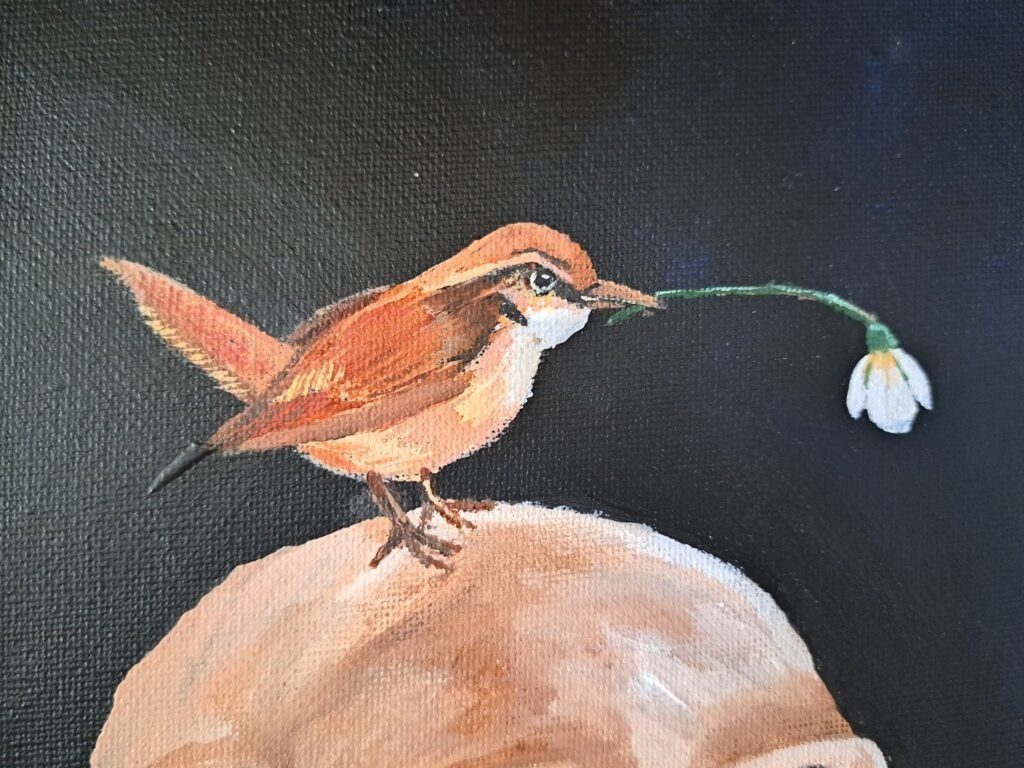
The Wren and the Snowdrop: Returning to Voice
Balanced atop the skull is a wren holding a snowdrop gently in its beak. The wren is a symbol of song, joy, and attentiveness. It is a small bird with a powerful voice.
Positioned on the skull, it suggests creativity rising from truth rather than denial. The snowdrop, often the first flower to bloom after winter, carries associations of rebirth, hope, and emergence after darkness. Together, the wren and snowdrop speak to the return of artistic voice. That voice may have changed after my break to focus on motherhood, but remains intact.
The Gypsy Moth: Heritage, Movement, and Cultural Overlap
The gypsy moth appears in Reclaiming as a deliberate reference to my paternal ancestry.
In 2020, I went on a journey to discover my paternal ancestry. I did not learn about this aspect of my ancestry growing up, nor did my father. But I wanted to teach my children about their heritage. The only starting point for my research into our heritage was a message, “Born in Bukovena”, on my great-grandfather’s tombstone and our last name.
I have always had a deep connection to mother earth and a nomadic spirit, having lived in multiple provinces, and moved to the foothills of the Rocky Mountains after my 3rd child was born. It was there that I took up the challenge of discovering my ancestry - a nomadic community from the Carpathian Mountains. When I learned this there was something in me that just felt home in that knowledge - it made sense.
I am Hutsul and Roma. Historically, Hutsul culture has often been conflated with or compared to Romani (“Gypsy”) culture by outsiders due to visible overlaps: vibrant folk dress and artistic expression, oral storytelling, and a reputation for independence and resistance to rigid social structures. While Hutsuls and Romani peoples are distinct in origin, language, and history, both cultures have been marginalized, romanticized, and misunderstood. Many families, like mine, also share both cultures.
The gypsy moth, therefore, functions on multiple levels. It symbolizes transformation and inherited identity - something carried quietly, sometimes problematically named, yet deeply personal. Its placement on the books links heritage to knowledge: history learned, mislearned, reclaimed, and reinterpreted through one’s own voice.
The gypsy moth in Reclaiming reflects this layered identity. Its symbolism is not spectacle or invasion, but presence and pause. Positioned on the books, it connects heritage to knowledge. A history inherited, interpreted, reclaimed, and reexamined through one’s own voice.
The moth acknowledges transformation that comes through interruption, and identity shaped by movement rather than stasis.
Ladybugs: Protection Along the Way
Scattered throughout the composition are small ladybugs, subtle but persistent. Traditionally symbols of protection and quiet good fortune, they act as gentle reassurances within the painting. Their repetition suggests unseen support. Look for small signs that appear when needed; they often go unnoticed until you pause for reflection.
Pearls at the Edge: Redefining Value
Finally, a string of pearls slips toward the edge of the table, nearly falling. Pearls, long associated with wealth, purity, and inherited value, are caught just in time by the candleholder.
This moment of tension reflects a reassessment of worth: what is allowed to fall away, and what is consciously retained. The pearls are not discarded, but restrained. This is not by accident, but by intention.
Reclaiming is my re-emergence into the art world. It is me, redefining my value as an artist.
Creative Paths Forward
Reclaiming is not about regret for time taken, nor an attempt to erase the years devoted to motherhood.
It is an acknowledgment that creative paths are not linear, and that pauses do not negate purpose. It is a declaration of return: grounded, deliberate, and claimed on my own terms.
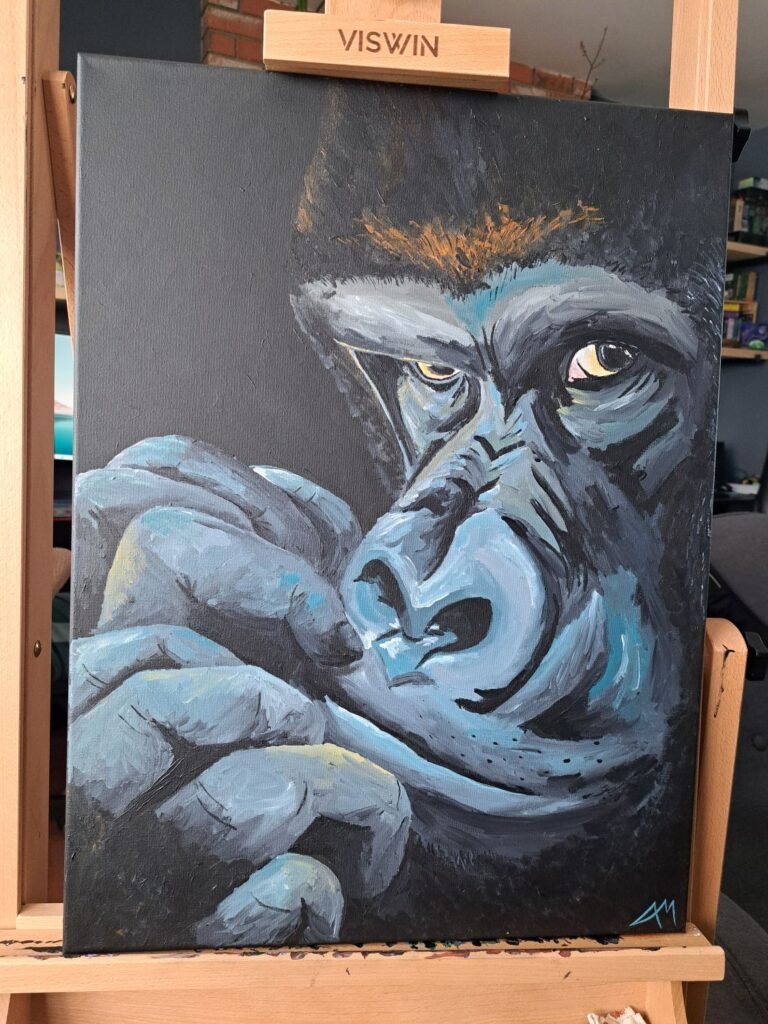
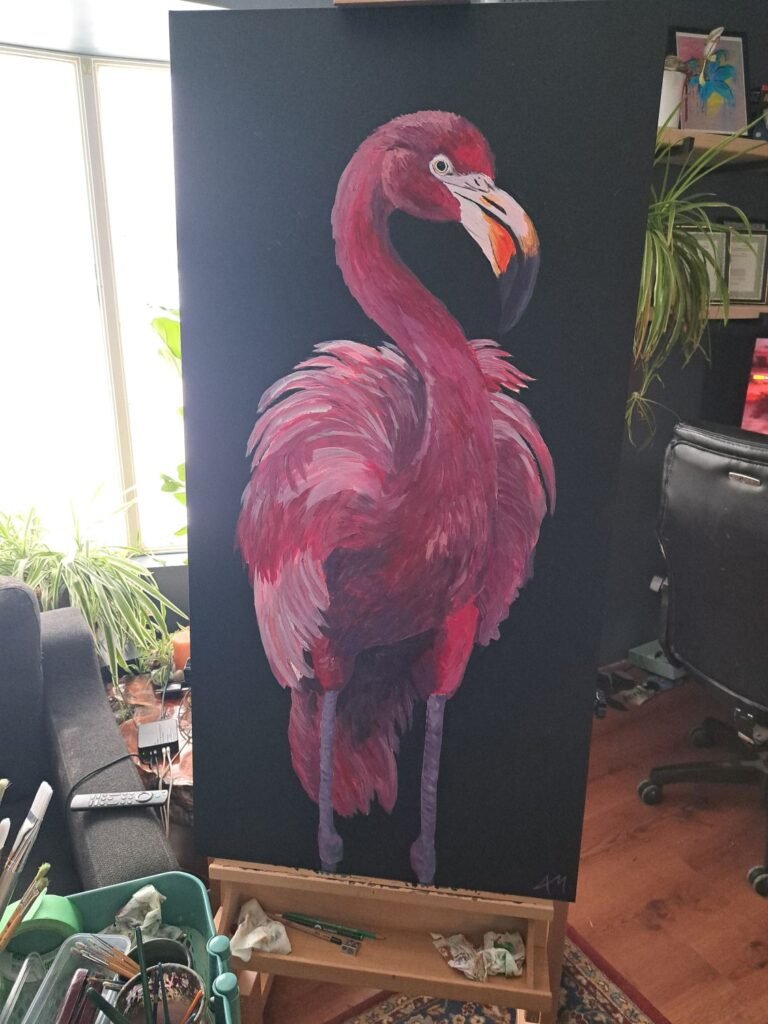


Another one of my favourite pieces of yours. It’s pure magic! Congratulations! Another job well done!